Project Summary
- Objective: A team at Sonos was considering making an upcoming product feature “smart” (learn users’ behaviors over time and adapt accordingly), but they weren’t sure how users would feel about this or how to provide the best possible experience.
- Research Methods: Diary study & interviews
- Impact: The research revealed the importance of users feeling like they have control over a product’s behavior, as they expressed frustration about previous experiences with “smart” products behaving in undesirable ways. My insights and recommendations led to a proposed experience for this product feature that would allow the feature to still be impactful as a “smart” feature, while minimizing disruption in the user experience.
Introducing The “Smart” Dimension
A new product feature that would impact upcoming Sonos products had been in development for a while. I had previously partnered with product managers and UX designers to do research that informed preliminary decisions about this feature. However, our Advanced Technology team proposed a new dimension to this feature: what if it was “smart”? What if, instead of having users control when they want the feature to activate, the system could learn users’ behavior over time and adapt when the feature activates accordingly? This was a feature that could be potentially disruptive to the user experience if it activated at unwanted times, so learning more about the user perspective about this was critical. Ideally, from a technical perspective, this feature would be activated whenever the Sonos system was not in use, so a “smart” adaptation might look like this:
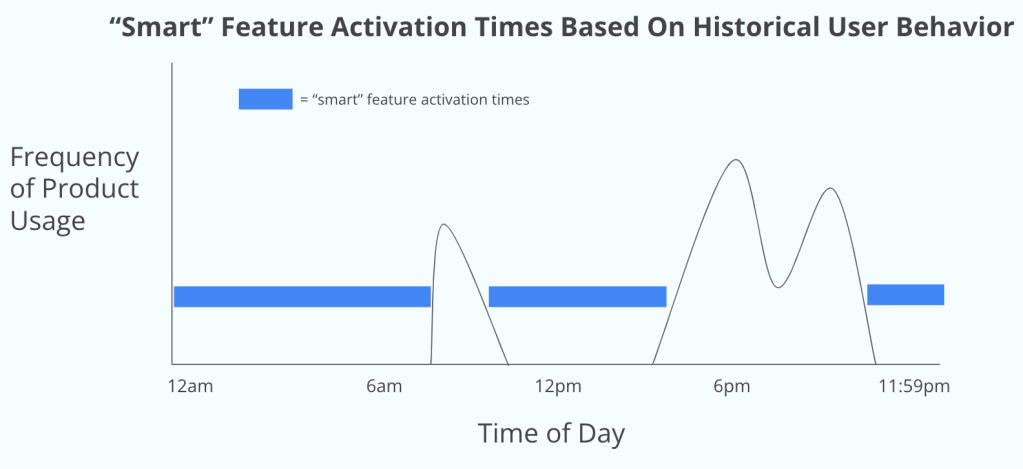
I spoke with UX designers, the product manager, a data scientist, and an advanced technologist to gather as much information from them as possible about what information they would need to make decisions not only for this feature, but for other potential “smart” features moving forward. This led to several research questions that could inform the design of the feature, including:
- How would users feel about this feature being “smart”?
- How much control, if any, would users want to have over this feature? Should it be completely automated?
- How do users feel about smart products in general?
- What do users like about smart products? What do they dislike about smart products?
- What do users think makes a product “smart”?
A Two-Part Study
I recruited 12 people with a variety of experiences with smart products. Some participants only had 1, while others had homes decked out in smart products. We had 4 couples and 4 individuals. I felt this represented many types of users and would allow us to get different perspectives while still identifying overall themes regarding smart products.
Because the team wanted to learn both about smart products in general and our specific concept of a smart feature, I split the study into two parts using the same participants: a diary study (on the dscout platform) and an interview (via Zoom). The diary studies were done individually, while the interviews were done in pairs for those who were recruited as a couple.
The diary studies focused primarily on users’ current experiences with “smart” products. I felt this was a good choice because it gave participants the ability to upload photos and videos, and allow us to better understand their specific home context. I had participants show us and tell us more about:
- Their favorite smart product they’ve owned and why
- Their least favorite smart product they’ve owned and why
- How they feel about smart products in general
Since the diary studies were more broad, I used the interviews to narrow down the focus to our specific smart feature. During the interviews, I covered:
- Any questions I had about what participants wrote in their diaries
- Our proposed concept of the “smart” feature
- How users would ideally want this “smart” feature to work
Users Need to Feel in Control
Above all else, the most valuable insight gained from this research was that, especially in regards to “smart” features, users need to feel like they have control over what is happening with a product.
In general, “smart” products and features are not a big deal to users, as long as they work the way the user expects and can control them when they don’t. Most of our participants shared stories about frustrating times when a device was supposed to be “smart”, but performed in an unexpected or unwanted way. During these times, users felt they lacked the control to get the product to do what they wanted. Some users stopped using devices entirely when they felt they were not behaving in a truly “smart” way.
This helped me identify a critical issue with our feature being “smart”. If the system learned to activate the feature, which could be disruptive, at certain times based on historical usage, then any attempts to use the products at atypical times could cause a frustrating experience.
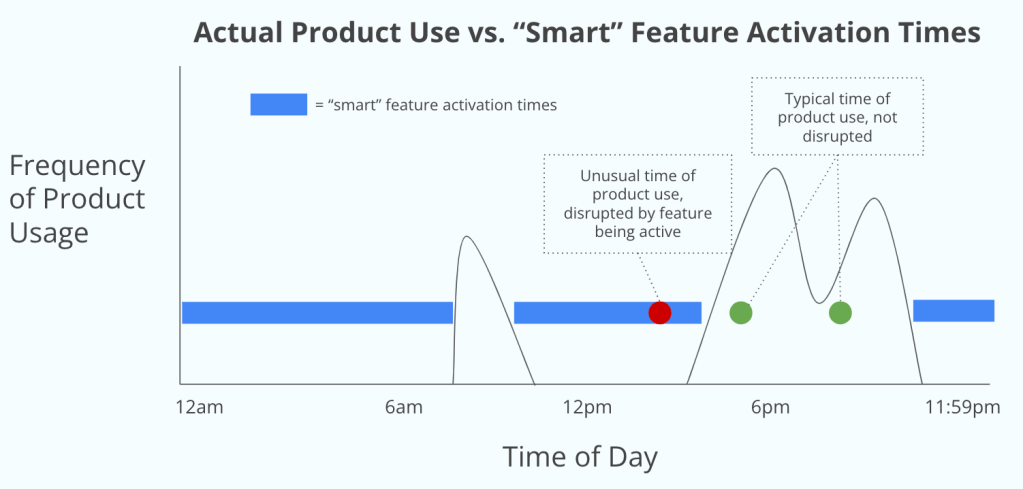
Therefore, the team learned that the ability to still give users a level of autonomy over the feature was important. This included recommendations such as:
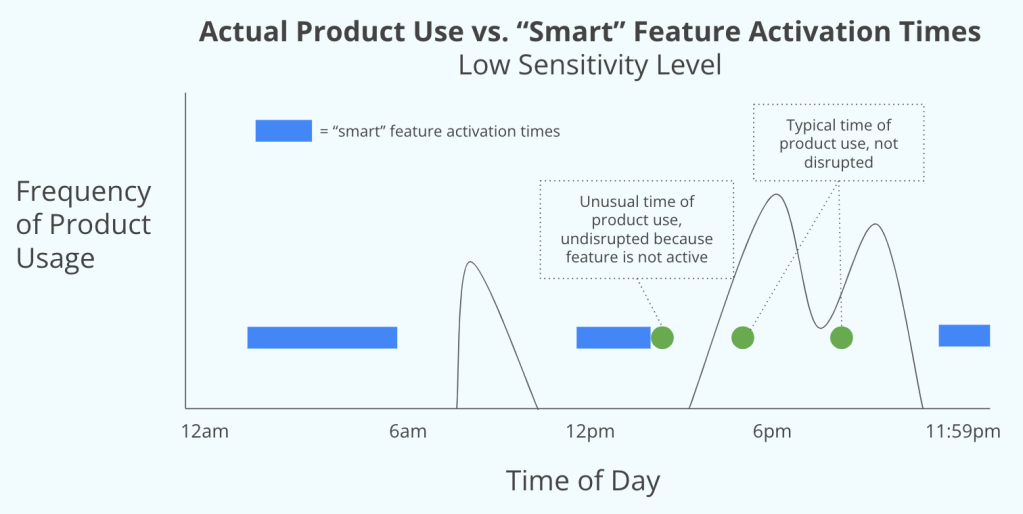
- Give users the option of varying “levels” of sensitivity to their behavior to determine when the feature would activate. Lower sensitivity levels would activate the feature less frequently to decrease the chance of disruption, but still be based on historical behavior. Therefore, a lower sensitivity level might look more like this:
- Have the option to turn off the “smartness” of the feature altogether and instead manually set the feature’s activation, as opposed to it exclusively learning and adapting over time
- Include clearer language in the app about the feature, what it does, and how it may impact their experiences to allow users to make the most informed decision about what they want their experience to be like
These recommendations have been included in the continued development of the feature, and the team expressed their gratitude for this deepened understanding of users and smart products.
 Jill Davidson